Criticisms
Artistic World
2025
Painterly Strategies against the Power of Signs
Park Jung Hyuk explores multiple layers of visual art through various media, including painting, installation, and video. His work closely examines the structure, meaning, and affective power of images.
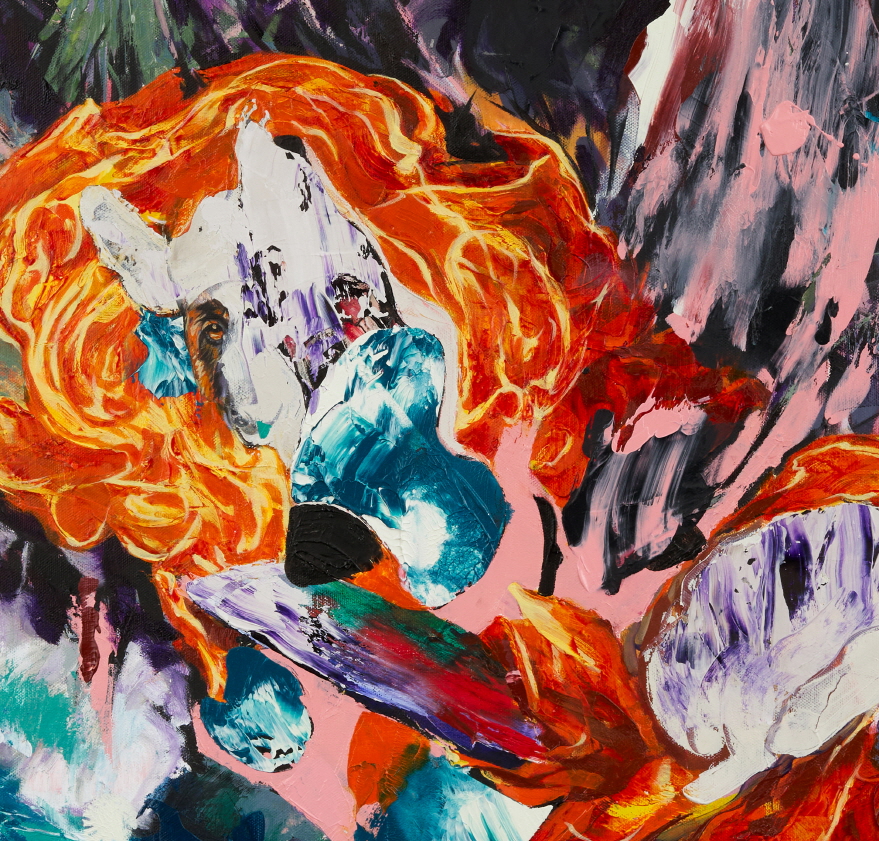
His paintings recombine fragments of images extracted from mass media, strategically disrupting the viewer’s habitual sensory framework. Visual elements appropriated from film, television, advertising, and magazines are recontextualized within a painterly framework, allowing the artist to expose the political nature of visual perception and the inherent instability of sensory experience.
《Park’s Park》– Image Experiments that Dismantle the Structures of Signs and Power
‘Park’s Park’ marks the starting point of Park’s painting practice and critically investigates the semiotic nature of images and their embedded power structures.
Rather than merely appropriating or reproducing mass-media imagery, Park rearranges familiar visuals to estrange them. In doing so, he exposes how such images function as conduits of social desire and instruments of control. Once removed from their original context, these images collide, overlap, and generate unfamiliar sensory effects.
This strategy destabilizes normative modes of viewing and prompts reflection on how we have been conditioned to see, as well as how images manipulate desire and perception.
‘Park’s Park’ serves as both a painterly device that reveals the political nature of imagery and a conceptual foundation for the artist’s subsequent work.
《Park’s Memory》– Surface Experiments that Reveal the Fluidity of Sensation and Memory
In 'Park’s Memory’, Park uses silver PET film—commonly found in pharmaceutical packaging—as the surface for oil painting. This nontraditional material introduces reflection, blur, and distortion, allowing images to hover in an unresolved, suspended state. The PET film reacts to environmental light, making the imagery inherently unstable and fluid.
Through this approach, Park shifts the concept of painting away from a “finished image” toward an open-ended event that captures temporal and sensory flux. The result is a painterly field where fragmented memories and shifting affect are allowed to emerge.
《Park’s Land》– A Visual Narrative of Transformation and Ontological Mutation
In ‘Park’s Land’, Park deconstructs and layers classical mythology and cinematic figures, using them as a means to explore the possibility of radical transformation. His figures dissolve, overlap, and reconfigure into new forms that signal the instability and fragmentation of contemporary identity.
This metamorphosis is not a mere alteration of form—it reflects today’s shifting ontological conditions, in dialogue with phenomena such as the metaverse, avatars, and multiple digital selves. Park visualizes this fluidity and multiplicity of being through painterly language.
Painting as Disruption, Reflection, and Expansion
Park Jung Hyuk’s painting practice transcends the conventional boundaries of form and concept, delving into the complex relationships among visual culture, capitalism, power, desire, and identity.
By dismantling and overturning the contexts of familiar imagery, Park disrupts the viewer’s perceptual habits and challenges the very act of seeing. The reflective and unstable surfaces of PET film, fragmented forms, and juxtaposed visual elements transform painting into a site of sensory experimentation, semiotic reconfiguration, and ontological inquiry.
Through visual strategies of layering, disintegration, reflection, and distortion, Park reveals the contradictions and anxieties of contemporary society and its hybrid sensory condition.
Ultimately, Park Jung Hyuk’s painting asserts the relevance of painting as a vital medium in an age overwhelmed by imagery and visual saturation—an age in which surface abundance often fails to capture the depths of human emotion, memory, and being.
His work, by embracing fragmentation and perceptual instability, attempts to reach something more complex, more vulnerable, and more deeply human. It raises pressing questions about how painting today can regenerate its meaning and sustain its relevance within our contemporary image-saturated world.
Writings