Texts
Reading a Painting #1 – Park Jung Hyuk’s Territory Shaped through Mytheme
2023.05.19
Kim Bom
‘Park’s Land’ Series_ @Arting Gallery
Reading a Painting #01
Milan Kundera, in 『Testaments Betrayed』, cites Rabelais’ book 『Gargantua and Pantagruel』 and writes that the novel is, fundamentally, a territory where moral judgment is suspended. He adds that this suspension itself constitutes the novel’s morality — a morality that stands in opposition to the deeply ingrained human impulse to judge incessantly and immediately, to pass verdict before understanding. Kundera further reflects on how monumental an achievement it is to suspend moral judgment and to create an imaginative field. (Milan Kundera, 『Testaments Betrayed』, pp.14–15.)
A novel is a world completed by entities conceived as autonomous beings, grounded in their own morality and laws (ibid., p.15). It is also a territory where new individuals and new freedoms exist — distinct from any pre-existing truth. What could be more compelling than such an endlessly possible world?
Just as Kundera described the novel as a territory where morality is suspended, here too exists another such territory. These are the works presented in Park Jung Hyuk’s solo exhibition. Currently on view at “Arting” in Hongje-dong, the exhibition titled 《When Ero•Gro•Nonsense Combines Nonlinearly》 captures the attention of devoted viewers of contemporary art.

Arting Gallery ©Writer
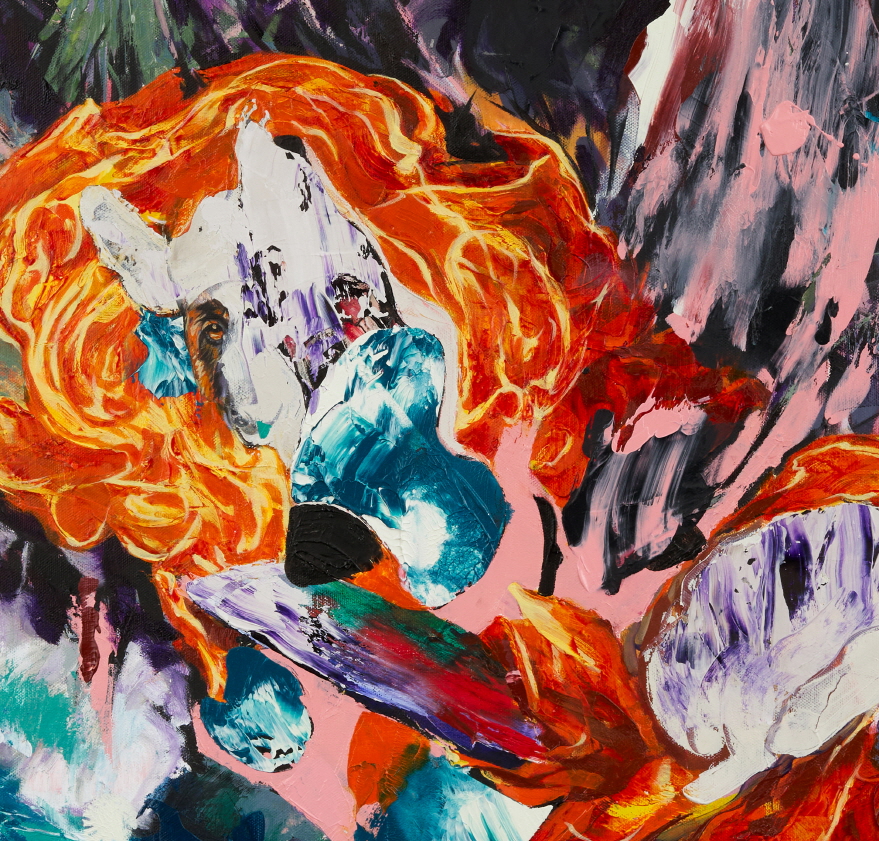
Without individual subtitles and numbered simply as ‘Park’s Land’, the works resist clear demarcation as singular objects. Yet within each canvas, one can discern an intrinsic morality and set of laws that operate on their own terms.
- The Possibility of Recomposition through Mytheme
‘Define nothing. It is enough to witness the moment.’
It would be premature to declare, of the ‘Park’s Land’ series, “This is it.” A narrative once formed is always poised to leap into an entirely different narrative under another time and circumstance.
Such leaps and flights are completed through the expansion of the mytheme. A mytheme, in structuralist terminology, refers to the fundamental unit that compresses the informational content of natural phenomena — the essential component necessary for constructing myth, including characters, events, and settings. In the ‘Park’s Land’ series, there is a particular pleasure in reading the canvas through the discovery of these mythemes.
Haruki Murakami, known for expanding novelistic narratives through the use of mythemes, advances his stories by employing wells or underground caves as narrative levers. Within the familiar, he inserts the unfamiliar, situating the reader at a point that suddenly feels entirely strange and complex. A subtle push and pull begins. Like chess pieces already placed on the board, readers find themselves inevitably drawn into narratives that are both familiar and alien. Each time they pass through the enigmas woven by the interaction of mythemes, they savor the pleasure of storytelling.
Just as Murakami constructs worlds, territories, and characters from mythemes, so too within Park Jung Hyuk’s world do countless narratives emerge from such fundamental units. These worlds and territories exist in states of excess and overflow, at times leaping far beyond expectation. Before the canvas, viewers inevitably imagine and generate innumerable narratives — abundant, overflowing, familiar yet estranging — immersed in the pleasure of such storytelling.
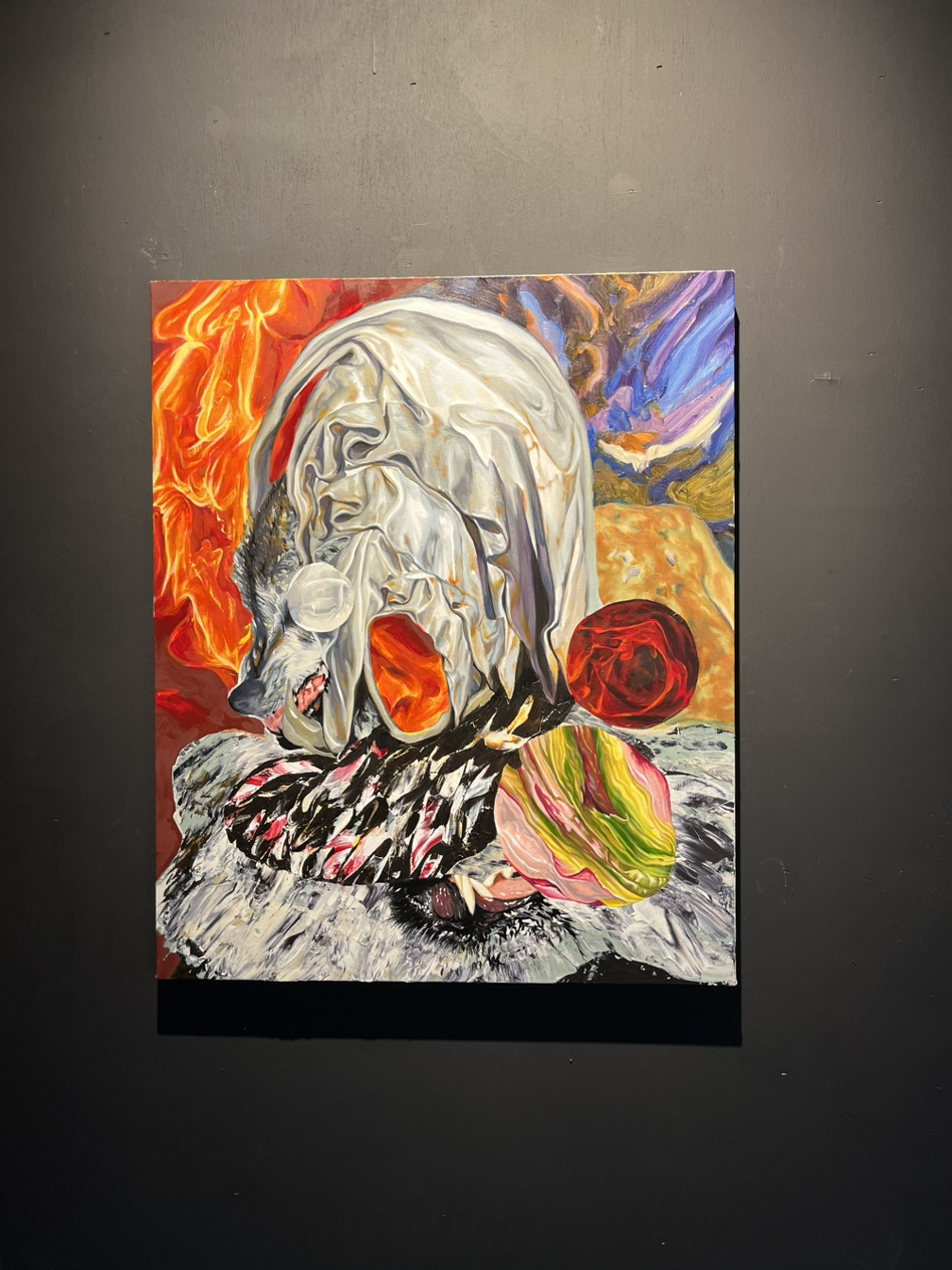
Park's Land 27-Wolf, Maria’s Growing Veil, 2023, Oil on canvas, 60.6 x 50 cm ©Writer
At the entrance, the work that first draws the eye — Park’s Land 27 — presents unfamiliar iconographies intertwined: a veiled head (recalling the veil of the Virgin in the Pietà) and the furrowed snout of what appears to be an enraged wolf. Though heterogeneous, these images summon other familiar narratives. The wolf, the Virgin, flames, drips, what is concealed beneath the veil — these mythemes appear like fragments or sudden apparitions. Yet each carries a certain preconditioned resonance while continually differentiating itself and expanding into new imaginative terrain.
Because of this peculiar dynamic, one must attempt to see again — a step closer, or several steps back. The familiar yet strange sensation that shifts with each viewing arises because, at the moment the viewer confronts the canvas, the mythemic function condensed within each icon activates almost instantly in the mind. It is precisely here that the ‘Park’s Land’ series demands attention.
Within Park Jung Hyuk’s territory — where definitive meanings are perpetually deferred — even more narratives unfold. One moment, time seems stolen by crimson flames; the next, the tilted snout of the wolf conjures the red cloak. The sorrowful gaze of the Virgin may surface, followed by recollections of the Twelve Labors of Hercules. Yet imagination does not expand through visible iconography alone. Through heterogeneous composition, roaring color, and the interaction of mythemes, a free territory of incessantly activated possibility comes into being.
Each icon can generate an independent narrative, yet through their combination they may also ascend into something excessive, beyond themselves. The moment an icon connects to linguistic symbolism, it performs a meta-linguistic function that exceeds ordinary language and produces a new context. Mythemes, readable across multiple contextual layers, assume entirely different narratives depending on the framework in which they are categorized. Thus, viewers find themselves continually standing before new challenges — familiar yet estranged, ordered yet reversed.
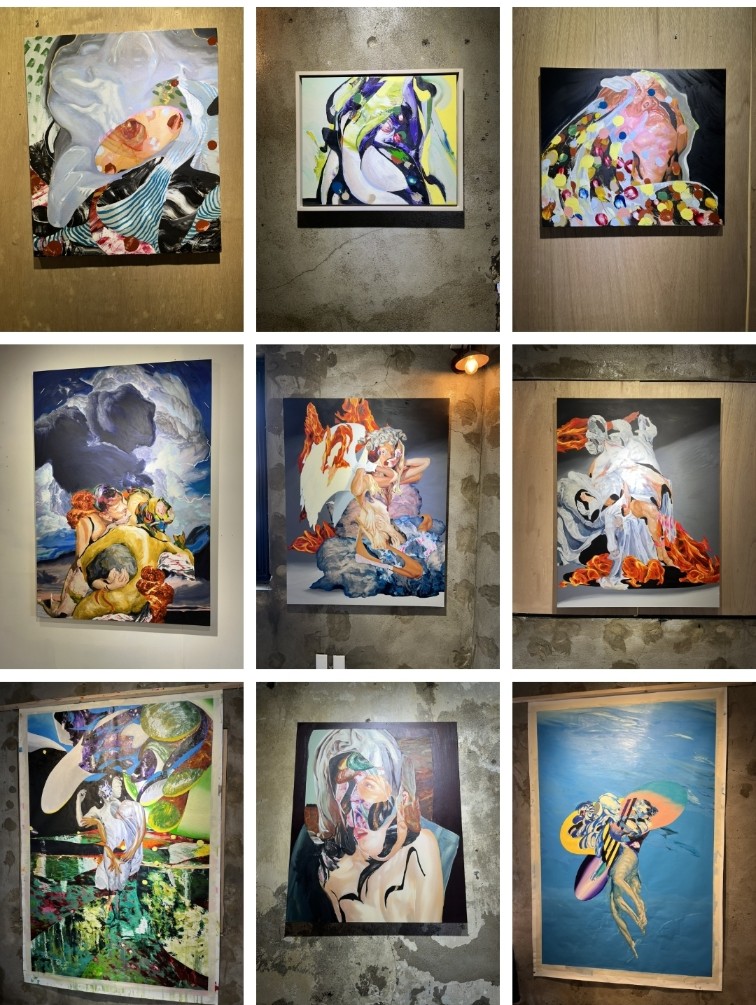
Exhibition Works ©Writer
The ‘Park’s Land’ series also reveals various bodily organs in their raw state. Mouths that seem about to speak yet remain silent; eyes that are open but do not clearly fix upon any object; hands that point toward nothing. Viewers are prompted to imagine unspoken languages beyond the canvas, moments that can no longer be seen, and objects that cannot be touched. These, in turn, generate further words, moments, and presences. By suspending their innate biological functions, these organs foreshadow the birth of another intensified sensibility.

Exhibition Works ©Writer
Simply by reading the painting, one feels saturated — as though having lived through countless narratives. One becomes intoxicated by this sensation.
In a certain sense, I sometimes think all art is pornography — because it persistently exceeds the limits of excess, and through that transgression opens new horizons. It becomes a leap, a flight. Through Park Jung Hyuk’s new territory, I hope that viewers — and readers who attempt, like myself, to read the canvas — will unfold an imagination that is ‘completely free, distant from anywhere and anyone.’
References
Writings